

Even the most effective active ingredient cannot perform optimally in isolation. How a cosmetic product behaves on the skin depends on the balance of the entire formulation – the aqueous phase, the lipid phase and the structure of the emulsion itself. Developing a product for dry and demanding skin requires the careful integration of four key elements: water binding, protection against moisture loss, a pleasant sensory profile and formulation stability. We explain, step by step, how to select the appropriate raw materials for each of these functions – in both lightweight emulsions and rich protective creams.
1. Dry skin is not simply a lack of water
Skin dryness can have a variety of causes. It is influenced not only by the water content of the stratum corneum, but also by the skin’s ability to retain moisture and the condition of the epidermal barrier itself. When these mechanisms are impaired, transepidermal water loss (TEWL) increases, and the skin becomes rough and begins to flake [1, 2].
For the formulator, this leads to one clear conclusion: a humectant alone is not enough. A water-binding ingredient addresses only one part of the problem. If the lipid phase does not provide adequate protection and the cream structure compromises uniform application, the product will not deliver the expected performance.
Instead of searching for a single “most powerful” raw material, it is more effective to build a coherent moisturising and protective system in which each component performs a specific function:
humectants – bind and retain water within the stratum corneum;
occlusive agents – form a protective barrier and reduce TEWL;
emollients – provide slip, softness and a pleasant after-feel;
the emulsifying and structuring system – combines the aqueous and lipid phases while providing a stable product format that is easy to apply.
2. How to select a humectant and minimise tackiness?
Humectants are responsible for binding water and increasing the hydration of the stratum corneum [1–3]. In formulation practice, however, their role must be considered more broadly than from the perspective of moisturisation alone. The use level and physicochemical properties of a raw material directly affect pH, viscosity and the way the product behaves after application.
The appropriate choice depends on the intended product profile. In a lightweight body lotion, a comfortable after-feel will be the priority. In a specialised hand or foot cream, the consumer-recognisable role of the ingredient and its potential to support premium product positioning may also be important.
Depending on the desired moisturisation profile, two different approaches can be taken when designing the aqueous phase:
Urea (pharmaceutical-grade urea, Ph. Eur.) – a component of the natural moisturising factor (NMF), particularly suitable for formulations intended for dry, rough and demanding skin, including hand and foot care products. At lower use levels, it provides intensive moisturisation, while at higher concentrations it exhibits keratolytic activity. The pharmacopoeial grade Urea Ph. Eur. provides an additional quality attribute that can support premium product positioning,
Hydrogenated Starch Hydrolysate (Sorbitol LGK Ph. Eur.) – a liquid, non-crystallising humectant with film-forming and conditioning properties. It is particularly suitable for the aqueous phase of body lotions and milks intended for daily care, where effective moisturisation needs to be combined with a lightweight, pleasant texture. Compliance with Ph. Eur. and NF standards makes Sorbitol LGK suitable for projects subject to more stringent quality requirements..
Humectant selection does not have to be an either-or decision. Combining two different raw materials allows their functions to be distributed across the formulation, helps avoid an excessively high use level of a single ingredient and enables better control of formulation viscosity.
What should be evaluated?
the effect of the humectant on pH and the final viscosity of the formulation;
perceived tackiness immediately after application and the characteristics of the residual film;
compatibility with the other raw materials in the aqueous phase;
the performance of the raw material at its intended use level
3. Emollients and occlusive agents – how to build a protective yet comfortable lipid phase?
In products intended for very dry skin, a humectant alone is not sufficient. When the epidermal barrier is compromised, occlusive agents become essential. They form a protective layer on the skin’s surface and reduce water evaporation [1, 3]. This approach is particularly important in hand and foot care products, as well as in formulations designed to protect the skin against detergents or low temperatures.
Formulation expertise, however, is not about achieving the strongest possible occlusive effect. An excessively heavy lipid phase can result in a greasy feel, a tacky film and increased drag during application. The objective is to achieve the optimum balance between protection and user comfort.
Protection and occlusion – supporting barrier restoration
Lanolin (EWALAN 30-PA) – anhydrous lanolin that imparts emollience, plasticity and protective properties to the lipid phase. It is particularly suitable for rich protective creams, water-in-oil (W/O) emulsions and anhydrous formulations.
Petrolatum (yellow petroleum jelly) – a classic occlusive agent that forms a robust hydrophobic film. It is particularly valuable when the formulation requires maximum protection against water loss and a richer, more perceptible skin feel is acceptable.
Emollients – controlling slip and the sensory profile
Occlusion alone does not determine product performance. Emollients influence how easily the product spreads and how it feels on the skin. Application properties can also be correlated with instrumental testing, for example through measurements of the coefficient of friction [4].
Caprylic/Capric Triglyceride (NEOMIN TCC) – a liquid emollient derived from renewable sources, characterised by a medium spreading rate. It provides a versatile base for the oil phase and improves slip in both lightweight body lotions and nourishing creams.
Ethylhexyl Stearate (NEOMIN OS) – a liquid emollient that helps balance more complex lipid systems. In higher-viscosity creams, it improves the spreadability of formulations based on lanolin or other high-consistency materials.
Liquid emollients do not replace lanolin or petrolatum, but provide an effective counterbalance to them. In lightweight emulsions, they form the foundation of the oil phase, while in rich creams they help reduce the heavy sensory profile associated with occlusive agents.
What should be evaluated?
slip and drag during spreading;
the degree of greasiness immediately after application and after several minutes;
the intensity and characteristics of the residual film;
the balance between protection and sensory comfort;
the effect of the lipid phase on emulsion viscosity and stability.
4. Selecting the emulsifying system and developing the emulsion structure
Selecting humectants, occlusive agents and emollients is only the first stage. The next step is to combine them in a stable emulsion with the required consistency and target application profile.
In practice, achieving the target viscosity alone is rarely the main challenge. Rheological behaviour and texture influence the product’s appearance, how it is picked up from the packaging and how it behaves during spreading. Since not every aspect of the after-feel can be predicted using a single measurement, instrumental evaluation should always be complemented by application and sensory testing [5, 6].
How to select an emulsifying system for the intended product profile
Cetearyl Alcohol, Ceteareth-20 (NEOWAX B1) – a non-ionic emulsifying and structuring system for oil-in-water (O/W) emulsions. It combines emulsification with consistency-building properties, providing an effective starting point for the development of a stable emulsion base.
Sorbitan Oleate (LAUROPAN S/80) – a lipophilic emulsifier recommended for water-in-oil (W/O) systems and anhydrous formulations where a more pronounced protective profile is required. In W/O emulsions, the oil phase forms the external phase, directly contributing to the occlusive effect. It is important to note that LAUROPAN S/80 is not a complete emulsifying base and requires precise selection of the remaining lipids, structuring agents and process parameters.
Cetyl Alcohol (CESTOPAL C16) – a structuring agent for O/W emulsions. It supports emulsion stability, increases viscosity and imparts a characteristic dry, waxy emollience to creams and lotions. Its inclusion and use level should be determined based on the performance achieved with the primary emulsifying system.
Four oversimplifications that can lead formulation development in the wrong direction:
A higher humectant level
does not always improve post-application comfort.
Stronger occlusion
does not always result in a better-balanced product.
Higher viscosity
does not guarantee an appropriate structure or comfortable application.
Easy spreadability
does not replace the function of an occlusive agent.
5. Two formulation profiles arising from different requirements
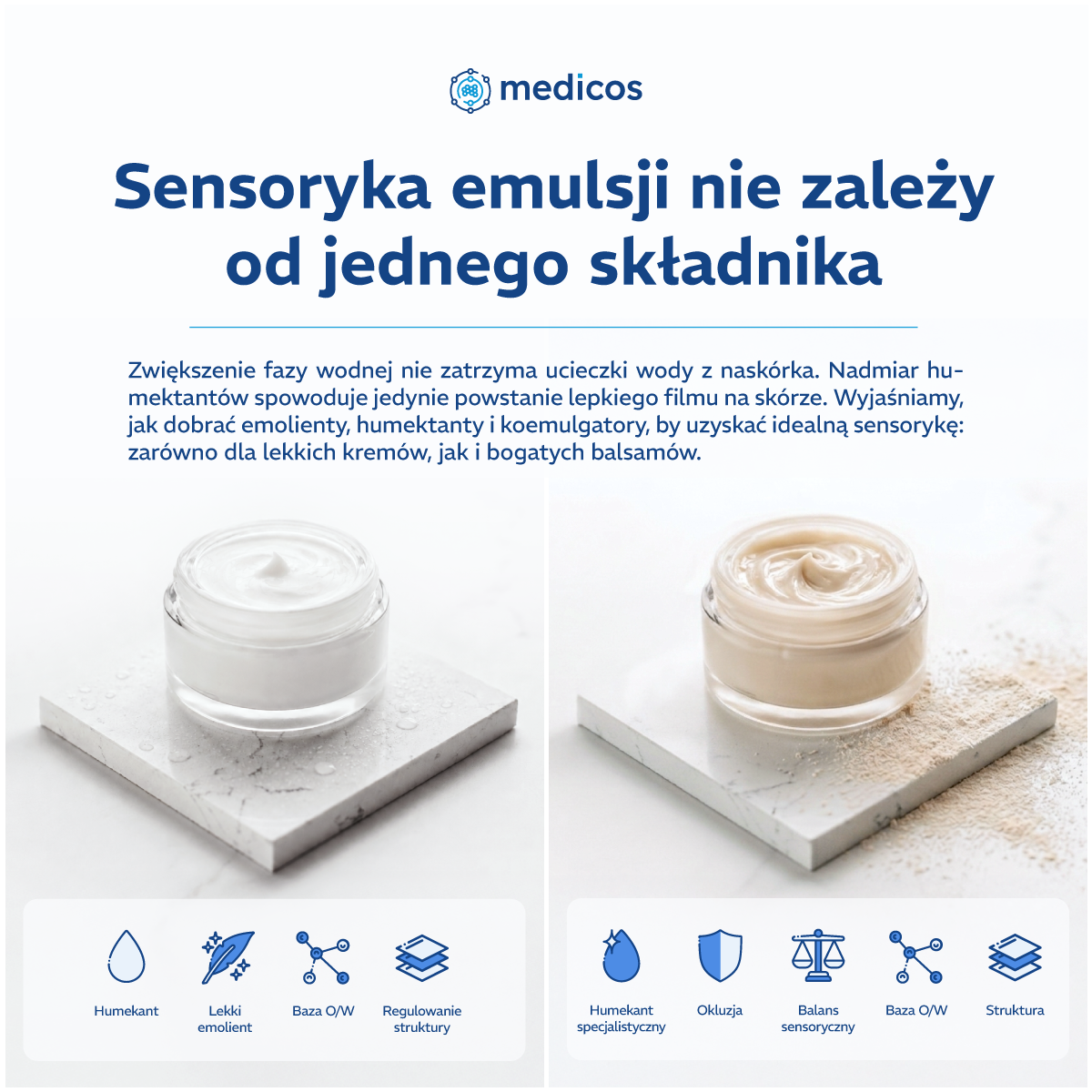
The development of a new cosmetic formulation should begin with a precise definition of the intended sensory and performance profile. The comparison below helps translate application requirements into specific raw material functions and highlights the main technological risks that should be considered during laboratory trials.
Decision criterion | Lightweight moisturising emulsion | Richer protective product |
Primary objective | Moisturisation, easy spreadability and a comfortable residual film without excessive greasiness. | Water binding, reduced moisture loss and a more pronounced protective profile. |
Example humectant direction | Hydrogenated Starch Hydrolysate (Sorbitol LGK). | Urea (pharmaceutical-grade urea, Ph. Eur.). |
Emollient phase | Caprylic/Capric Triglyceride (NEOMIN TCC) as a versatile liquid emollient. | Lanolin (EWALAN 30-PA) to build a rich, pliable lipid phase, supplemented with a liquid emollient such as Ethylhexyl Stearate (NEOMIN O 8). |
Level of protection and occlusion | Low, with no dedicated occlusive agent. The film profile is defined by the emollient and emulsion structure. | Moderate to pronounced. The lipid phase containing lanolin provides the primary protective profile, while Petrolatum can be used to increase occlusivity further. |
Emulsifying system | Cetearyl Alcohol, Ceteareth-20 (NEOWAX B1) as an O/W approach. | Cetearyl Alcohol, Ceteareth-20 (NEOWAX B1) for an O/W emulsion; Sorbitan Oleate (LAUROPAN 8/80) as a lipophilic emulsifier providing a starting point for a W/O system; alternatively, an anhydrous formulation. |
Structure adjustment | Cetyl Alcohol (CETOPAL C18) only if required. | CETOPAL C18 optionally, to achieve a firmer consistency. |
Key risk | Post-application tackiness, excessive waxiness or an excessively high oil-phase content. | A heavy skin feel, poor spreadability, excessive occlusion or an overly rich structure. |
The comparison outlines rational formulation strategies rather than a fixed formula. The presented options do not preclude combining different humectants or using them in alternative configurations. The final selection and use levels of individual raw materials should always be determined by the specific intended application of the target formulation.
6. What should be evaluated during formulation trials?
Technical specifications provide an initial indication of the function that can be assigned to a raw material. Its actual performance, however, must be evaluated within the target formulation. The same humectant, emollient or emulsifier may behave differently depending on its use level, the other ingredients present and the type of emulsion.
There is no single universal target value applicable to every formulation. The required parameters depend, among other factors, on the product type, preservative system, raw material stability and intended product claims.
Five key areas should be analysed in detail during formulation trials:
pH, viscosity and system stability – to determine whether the addition of a raw material shifts critical parameters outside the accepted range or disrupts the emulsion structure;
spreadability and after-feel – to confirm whether the levels of tackiness, greasiness and waxiness, as well as drag on the skin, correspond to the intended product profile;
characteristics of the residual film – to verify that an appropriate balance has been achieved between moisturisation, occlusive protection and user comfort;
compatibility with the other ingredients – to identify changes in consistency, phase separation, crystallisation or other undesirable phenomena in the aqueous and lipid phases at an early stage;
the need for additional emulsion adjustment – to determine whether the primary emulsifying system requires supplementation with a co-emulsifier or structuring agent.
Current specifications and technical data sheets should always provide the starting point. The next step is testing within the specific formulation base to confirm the target consistency, stability and sensory profile.
7. Moisturisation is the result of the formulation as a whole
An effective formulation for dry and demanding skin is never the result of a single ingredient. Its final properties depend on the careful balancing of humectants, occlusive agents, emollients and the emulsifying system. Changing even one component of the formula can simultaneously affect stability, consistency, slip and the final after-feel.
Are you selecting raw materials for a new emulsion or protective cream? We can help you identify the options best suited to your formulation brief. Contact us to obtain current technical specifications for Ph. Eur.-grade materials, check product availability and request samples for your laboratory trials.
Bibliography
[1] Lodén M. Role of topical emollients and moisturizers in the treatment of dry skin barrier disorders. American Journal of Clinical Dermatology. 2003;4(11):771–788. doi: 10.2165/00128071-200304110-00005.
[2] Piquero-Casals J, Morgado-Carrasco D, Granger C, Trullàs C, Jesús-Silva A, Krutmann J. Urea in dermatology: a review of its emollient, moisturizing, keratolytic, skin barrier enhancing and antimicrobial properties. Dermatology and Therapy. 2021;11(6):1905–1915. doi: 10.1007/s13555-021-00611-y.
[3] Draelos ZD. Therapeutic moisturizers. Dermatologic Clinics. 2000;18(4):597–607. doi: 10.1016/S0733-8635(05)70210-2.
[4] Savary G, Grisel M, Picard C. Impact of emollients on the spreading properties of cosmetic products: a combined sensory and instrumental characterization. Colloids and Surfaces B: Biointerfaces. 2013;102:371–378. doi: 10.1016/j.colsurfb.2012.07.028.
[5] Calixto LS, Infante VHP, Maia Campos PMBG. Design and characterization of topical formulations: correlations between instrumental and sensorial measurements. AAPS PharmSciTech. 2018;19(4):1512–1519. doi: 10.1208/s12249-018-0960-0.
[6] Li Y, Zhou Z, Zhao X, Zhao H, Qu X. The rheological and skin sensory properties of cosmetic emulsions: influence of thickening agents. Journal of Cosmetic Science. 2018;69(1):67–75.


