

Choosing between pharmaceutical-grade and technical-grade urea involves far more than cost optimisation. It is a strategic decision that directly affects product stability and safety. Although both grades appear under the same INCI name, they differ significantly in terms of actual purity levels and manufacturing standards.
This article examines how impurities that may not be immediately apparent can influence formulation shelf life, odour and process consistency.
For R&D: what should be evaluated before selecting a urea grade?
When comparing raw materials, it is worth assessing, above all, the quality standard and intended use of the specific grade, the limits for by-products and impurities (including biuret), the scope of batch testing and the information provided in the Certificate of Analysis (CoA), as well as batch-to-batch consistency and supply-chain traceability.
These factors become particularly important in high-urea formulations and in products where a high degree of process predictability and reproducibility is required.
Raw material specification and production consistency in demanding dermocosmetic systems
Urea is one of the most effective humectants used in formulations for dry and keratinised skin, but it requires a high level of technological discipline.
It is used across many industries and is therefore available on the market in two grades: pharmaceutical and technical.
Selecting the appropriate grade for cosmetic applications is essential to ensure product purity and maintain stable pH. Using an industrial-grade raw material in a cosmetic formulation can readily lead to hydrolysis, resulting in an ammonia-like odour and product crystallisation over time.
Understanding the key differences between the specifications of the two grades is therefore essential to minimise technological risk and ensure consistent quality of the finished formulation.
Urea grades – differences that are not immediately apparent
Different grades of urea are used across industry:
technical grade (industrial/technical grade),
pharmaceutical grade (pharmaceutical/medical grade).
Although they are chemically the same compound, they are materials intended for entirely different applications and subject to very different levels of quality control.

INCI indicates the presence of an ingredient, but not its quality
Urea (INCI: Urea; CO(NH₂)₂) is one of the most extensively studied and widely used ingredients in cosmetics and dermatology. Its ability to bind water, acting as a humectant, its exfoliating, keratolytic properties, and its impact on skin barrier function are well documented in both scientific literature and clinical studies [2–4, 12].
According to the Cosmetic Ingredient Review (CIR), urea is considered safe for use in cosmetic products. However, experts also highlight its important technological function: it may enhance the penetration of other ingredients into the deeper layers of the skin. It should also be noted that its absorption is significantly higher through damaged skin than through healthy skin [1].
In leave-on products and dermocosmetics, raw material quality is fundamental to product safety. Quality differences are not reflected in the INCI designation, but may become apparent in the stability of the formulation after several weeks or during a quality audit. The assumption that an identical chemical formula always translates into identical performance characteristics is therefore an oversimplification.
Industry literature indicates that the raw material grade determines its impurity profile, the stringency of microbiological control, batch-to-batch consistency and the long-term stability of the formulation [5, 6]. In practice, these parameters directly affect the physicochemical stability of the formulation, its sensory and visual characteristics, such as odour and colour, and the final safety assessment of the finished product.
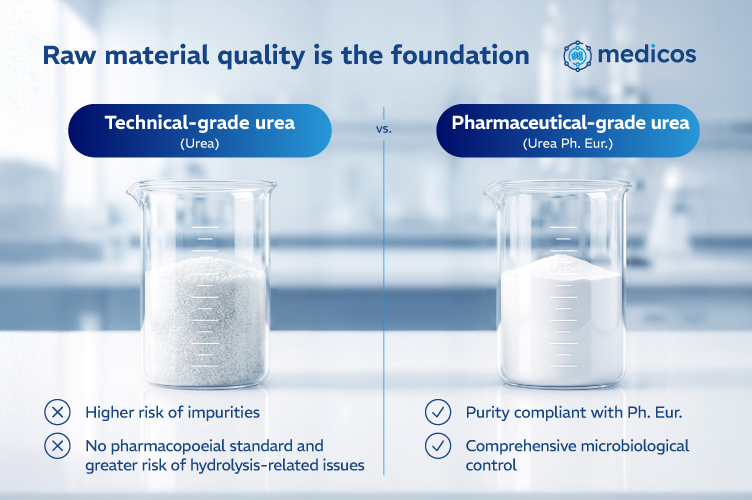
The key practical difference
Technical-grade urea
The scope of testing and parameter limits depend on the specifications defined for the specific product and manufacturer.
Before use in a cosmetic formulation, the intended application of the raw material, impurity limits and available documentation should be carefully verified.
Pharmaceutical-grade urea Ph. Eur./USP
Raw material parameters are assessed against defined pharmacopoeial requirements.
This facilitates compliance assessment, documentation review and comparison of parameters between successive batches.
In both cases, the decision should be based on the current specification and Certificate of Analysis (CoA) for the specific raw material, taking into account the requirements of the intended formulation.
Looking for urea compliant with Ph. Eur. specifications?
Review the product parameters, available documentation and technical information.


In podiatric formulations, such as creams containing 10–30% urea for dry skin, pharmaceutical-grade urea compliant with Ph. Eur. and USP standards provides a neutral sensory profile, with no undesirable odour, as well as hydrophilic properties and support for the penetration of other active ingredients. This is achieved through manufacturing under GMP conditions, full batch traceability, Halal and Kosher certification, and the absence of contaminants such as formaldehyde, PEGs or nanoparticles.
Even minor differences in raw material purity and quality control may cause interactions with other ingredients, pH drift, changes in colour or odour, and formulation instability. These factors are particularly important for the safety of products intended for sensitive or atopic skin [5, 6]. They also determine batch-to-batch consistency.
From a formulator’s perspective, urea is far more than a standard humectant. As a highly hygroscopic substance, it directly affects the moisture balance of the entire system. Its purity and packaging conditions may influence water activity and, consequently, the safety margin of the preservative system [11].
This effect is rarely noticeable immediately after production. It most often becomes apparent during long-term stability testing or as variations between successive production batches.

How impurities in technical-grade urea accelerate degradation and compromise formulation stability?
Technical- and fertiliser-grade raw materials are not designed for skin contact and are therefore not subject to the same chemical and microbiological purity requirements as pharmaceutical-grade materials [5, 6].
Technical-grade urea may contain elevated levels of process-related by-products, including biuret, whose concentration depends on the synthesis conditions [9] and is strictly limited under Ph. Eur. and USP requirements [7, 8].
Trace metals also represent a significant risk. Without stringent quality control, elevated levels of these impurities may initiate or accelerate oxidative reactions, particularly in formulations containing unsaturated lipids.
Formulation literature indicates that transition metal ions, such as iron and copper, act as catalysts in oxidation processes. This may lead to accelerated lipid degradation, undesirable colour changes and the development of off-odours [10]. In laboratory practice, this translates into a considerably higher risk of the product losing stability over time [5, 10].
Pharmaceutical-grade urea must comply with strict pharmacopoeial requirements, including Ph. Eur. and USP standards, which define impurity limits, microbiological control requirements and full traceability for each batch [7, 8]. In laboratory practice, this results in lower variability of the incoming raw material and greater predictability of formulation performance.
This is particularly important in products containing high concentrations of urea, typically 10–30%, and in dermatological applications.

Verification of certificate of analysis parameters – key purity indicators
The mere availability of a certificate of analysis (CoA) is only the starting point of the quality control process. What matters most is the ability to interpret impurity limits, which are strictly defined for pharmaceutical-grade materials. Particular attention should be paid to biuret content, as its degradation products may significantly reduce formulation stability.
The levels of heavy metals and process-related residues are equally important, particularly as these parameters may not be reported for technical-grade raw materials.
The transparency of pharmacopoeial documentation, including compliance with Ph. Eur. and USP requirements, enables a more precise assessment of potential risks before the raw material is introduced into the production process.
Need documentation for raw material evaluation?
We will send you the current specification, a sample CoA, and information on the availability of urea Ph. Eur. You can also request a sample for preliminary formulation testing.

Why raw material purity matters from both biological and formulation perspectives?
From a dermatological perspective, urea is not an inert ingredient. Studies have shown that it can influence the expression of genes associated with epidermal barrier function and antimicrobial defence mechanisms, while also improving skin barrier integrity [2, 3].
Its effectiveness in the care of dry and flaky skin, as well as in the treatment of selected dermatoses, has been clinically confirmed, particularly in formulations containing concentrations ranging from several to several dozen percent. At these levels, urea acts both as a humectant and as a keratolytic agent [3, 4].
At the same time, the CIR indicates that urea may enhance the penetration of other substances through the skin, while its absorption through a damaged epidermal barrier is significantly higher than through healthy skin [1].
This means that in leave-on products and dermocosmetics, urea functions not only as an active ingredient, but also as a modulator of the bioavailability of other formulation components. In this context, raw material purity is no longer merely a formal parameter. It becomes a critical element of biological and technological risk management.
The question is therefore not whether quality differences exist, but whether they are relevant to the specific application.
Criterion | Technical/fertiliser-grade urea | Pharmaceutical-grade urea |
Intended application | Fertilisers and the chemical industry | Medicinal products, dermocosmetics, OTC products and cosmetics |
Chemical purity | Variable, with no cosmetic-grade standards | Compliant with Ph. Eur./USP requirements |
By-products, e.g. biuret | Higher levels may be permitted | Strictly limited in accordance with the applicable standard |
Microbiological control | Usually not required | Mandatory in accordance with the applicable standard |
Batch-to-batch consistency | Limited | Very high |
Quality documentation | Minimal | CoA, SDS and full traceability |
Ph. Eur./USP compliance | No | Yes |
In practice, this means that lower-grade raw materials may introduce greater variability in chemical and microbiological impurities, directly compromising the physicochemical stability of the formulation. Industry literature confirms that the presence of such impurities may lead to pH drift, colour changes, deterioration of the odour profile and unpredictable interactions with the preservative system [5, 6]. It is at this stage that the differences between individual raw material grades cease to be merely theoretical and begin to have tangible operational consequences.
Thanks to guaranteed parameter consistency and stringent quality control, pharmaceutical-grade raw materials significantly reduce these risks, providing formulators with greater process predictability and helping to ensure the safety of the finished product.
Full traceability and pharmacopoeial standards as the foundation of process confidence throughout the supply chain
In an environment of increasing regulatory requirements, quality audits and increasingly detailed safety assessments, the choice of raw material grade is no longer solely an internal R&D decision. Product information file (PIF) documentation, safety reports and compliance requirements relating to REACH, ISO and GMP increasingly require manufacturers to provide a clear justification for selecting a specific raw material grade [7, 8].
In this context, pharmaceutical-grade urea should not be viewed simply as a “more expensive option”, but as a strategic tool for reducing regulatory and reputational risk. Guaranteed purity and comprehensive raw material documentation provide the foundation for process confidence, from certification through to the product’s presence on the market.
The impact of raw material grade on actual operating and process costs
When comparing the prices of different raw material grades, it is easy to focus on cost optimisation at the purchasing stage. However, the final calculation should also account for the potential costs of production downtime, the need to adjust the pH of manufactured batches, and the risk of disposing of a formulation that fails stability testing.
Choosing pharmaceutical-grade urea is therefore primarily an investment in process consistency. Shorter formulation development times and the elimination of costs associated with quality complaints represent tangible savings that may significantly outweigh the difference in the unit price of the raw material.

The importance of technological partnership for product stability and lifecycle management
In technological practice, raw material decisions are rarely based solely on purchase cost or availability. Above all, they determine the level of control maintained over both the manufacturing process and the finished formulation. Urea is a perfect example: theoretically simple, yet in practice it reveals critical quality differences during stability testing, safety assessments and audits.
The question is therefore not whether urea delivers its declared effects, as these have been clearly confirmed in the scientific literature [2–4], but what level of technological and regulatory risk is acceptable for a specific application.
In dermatological formulations, where urea enhances skin penetration [1] and is often used at high concentrations [3, 4], raw material quality becomes a key design consideration.
The role of a technological partner is not to impose specific solutions, but to enable a fully informed decision. Access to raw materials with clearly defined quality, comprehensive documentation and consistent parameters effectively reduces variability at the very beginning of the process. This allows R&D teams to focus on formulation development rather than managing raw material uncertainty.
From this perspective, selecting a specific grade of urea is, in practice, a decision about the level of control to be maintained throughout the entire product lifecycle, from the initial laboratory trials through to end-user satisfaction.

The importance of technological partnership for product stability and lifecycle management
In technological practice, raw material decisions are rarely based solely on purchase cost or availability. Above all, they determine the level of control maintained over both the manufacturing process and the finished formulation. Urea is a perfect example: theoretically simple, yet in practice it reveals critical quality differences during stability testing, safety assessments and audits.
The question is therefore not whether urea delivers its declared effects, as these have been clearly confirmed in the scientific literature [2–4], but what level of technological and regulatory risk is acceptable for a specific application.
In dermatological formulations, where urea enhances skin penetration [1] and is often used at high concentrations [3, 4], raw material quality becomes a key design consideration.
The role of a technological partner is not to impose specific solutions, but to enable a fully informed decision. Access to raw materials with clearly defined quality, comprehensive documentation and consistent parameters effectively reduces variability at the very beginning of the process. This allows R&D teams to focus on formulation development rather than managing raw material uncertainty.
From this perspective, selecting a specific grade of urea is, in practice, a decision about the level of control to be maintained throughout the entire product lifecycle, from the initial laboratory trials through to end-user satisfaction.
Bibliography
[1] Andersen FA, Bergfeld WF, Belsito DV, Hill RA, Klaassen CD, Liebler DC, et al. Final report of the safety assessment of urea. International Journal of Toxicology. 2005;24 (Suppl 1):1–23.
[2] Grether-Beck S, Felsner I, Brenden H, Kohne Z, Majora M, Marini A, et al. Urea uptake enhances barrier function and antimicrobial defense in humans by regulating epidermal gene expression. Journal of Investigative Dermatology. 2012;132(6):1561–1572.
[3] Piquero-Casals J, Morgado-Carrasco D, Gilaberte Y, Granger C, Fabbrocini G. Urea in Dermatology: A Review of its Emollient, Moisturizing, Keratolytic, Skin Barrier Enhancing and Antimicrobial Properties. Dermatology and Therapy. 2021;11(6):1905–1915.
[4] Lodén M. Urea-containing moisturizers influence barrier properties of normal skin. Archives of Dermatological Research. 1996;288(2):103–107.
[5] Barel AO, Paye M, Maibach HI, editors. Handbook of Cosmetic Science and Technology. 4th ed. Boca Raton (FL): CRC Press; 2014..
[6] Rowe RC, Sheskey PJ, Quinn ME, editors. Handbook of Pharmaceutical Excipients. 8th ed. London: Pharmaceutical Press; 2017.
[7] European Directorate for the Quality of Medicines & HealthCare (EDQM). Urea. In: European Pharmacopoeia. 11th ed. Strasbourg: Council of Europe; 2023.
[8] United States Pharmacopeial Convention. Urea. In: United States Pharmacopeia and National Formulary (USP–NF). Rockville (MD): USP; 2023.
[9] Sadeghi R, et al. Mechanism of biuret formation in urea production processes. Industrial & Engineering Chemistry Research. 2017;56(38):10887–10895. doi:10.1021/acs.iecr.7b02044
[10] Draelos ZD, Thaman LA, editors. Cosmetic Formulation of Skin Care Products. 2nd ed. Boca Raton (FL): CRC Press; 2006..
[11] Brannan DK, Dille JC. Cosmetic Microbiology: A Practical Approach. 2nd ed. Boca Raton (FL): CRC Press; 2006.
[12] Fluhr JW, Darlenski R, Lachmann N, Baudouin C, Msika P, De Belilovsky C, et al. Functional assessment of skin barrier integrity. Experimental Dermatology. 2008;17(12):1063–1072.


