

Two collagen hydrolysates may have a similar amino acid composition yet provide different peptides. The same name encompasses ingredients whose characteristics are shaped by their origin, the composition of the starting material and the way it is processed. [1] For formulators, this invites a broader view of collagen: one that connects its biological source with what ultimately goes into the formulation. Two ingredients should therefore not be compared solely based on the label “collagen”, or even “collagen hydrolysate”. In the case of TuriColl™, two aspects of this story are particularly interesting — its natural complex of components and the possibility of obtaining different hydrolysate profiles.
From tissue to hydrolysate
It is worth starting with collagen in its natural setting. Cartilage is a material with remarkable mechanical properties: it bears loads, deforms and helps maintain smooth movement. Its function depends on the organisation of the extracellular matrix. The collagen network, composed primarily of type II collagen, forms this structure together with proteoglycans and water. Negatively charged glycosaminoglycan chains promote swelling and resistance to compression, while the collagen network restrains this swelling and transmits stresses. [2] Biology offers an instructive lesson in materials design here: the properties of the whole also depend on the relationships between its components.
Hyaluronic acid and chondroitin sulphate also have a role in this structure. Hyaluronic acid participates in the formation of large proteoglycan aggregates, while chondroitin sulphate chains form part of aggrecan, one of the main proteoglycans in cartilage. [2] Their coexistence with collagen therefore has a biological basis. When assessing a collagen ingredient, it is worth considering these accompanying components as well. Their presence in the source tissue does not establish the composition of the finished ingredient — the production process and analytically confirmed levels of individual substances also matter.
For manufacturers, collagen origin is more than a marketing consideration. The animal species and tissue type determine the biological matrix with which the process begins. Skin, bone, tendon and cartilage are not interchangeable sources of the same protein. They differ in the proportions of collagen types, the degree of protein cross-linking and the presence of accompanying components.
The natural complex of components in TuriColl™
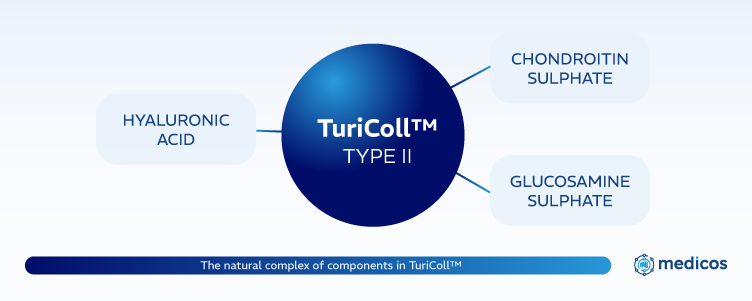
TuriColl™ reflects this approach: it is a hydrolysate obtained from turkey-derived materials rich in type II collagen. Alongside the collagen fraction, it contains hyaluronic acid, chondroitin sulphate and glucosamine sulphate derived from the same starting material. The composition of the finished ingredient is therefore shaped both by the natural composition of the source tissue and by how it is processed.
For product developers, this is an invitation to consider an ingredient’s full composition. Protein content describes one aspect; the presence of accompanying components adds another. In this way, the question of how much collagen is present becomes linked to the nature of the complex. The shared origin of its components also creates a coherent product story, rooted in the biology of the starting material.
Hydrolysis as part of ingredient design
Hydrolysis can shape an ingredient’s peptide profile, making it an important stage in ingredient design. The enzymes used, process conditions and the point at which hydrolysis is stopped influence the length and composition of the resulting protein fragments.
The process therefore affects not only average molecular weight, but also peptide size distribution, the proportion of free amino acids and the presence of larger polypeptides.
During controlled enzymatic hydrolysis, long protein chains are broken down into shorter fragments. This produces a new mixture of molecules whose characteristics depend on both the starting protein and the course of the process. In this context, the term “type II collagen” refers to the origin of the collagen fraction, while the peptide profile provides insight into the form of the processed ingredient. [1] These two levels of description complement one another: one points to the biological source, the other to the finished hydrolysate.
This distinction is easy to overlook when comparing only basic specifications. In an analysis of ten commercial collagen hydrolysates published in Molecules, similar amino acid profiles were associated with differences in peptide length and composition. [1] This means that a similar pool of amino acids can be present in different protein fragments. Peptide-level information therefore adds a dimension to ingredient assessment that an amino acid profile alone cannot provide.
Why does average molecular weight not tell the whole story?
Molecular weight deserves the same careful interpretation. A figure expressed in daltons is a useful reference point, but an average describes the mixture. Imagine two hydrolysates with the same average: in one, most molecules cluster around that value; in the other, numerous smaller and larger fragments coexist. Both can be described by a similar figure, although their molecular weight distributions differ. When comparing collagen ingredients, the shape of the distribution and the proportions of individual fractions therefore also become relevant. An example of a molecular weight (MW) distribution is shown below:
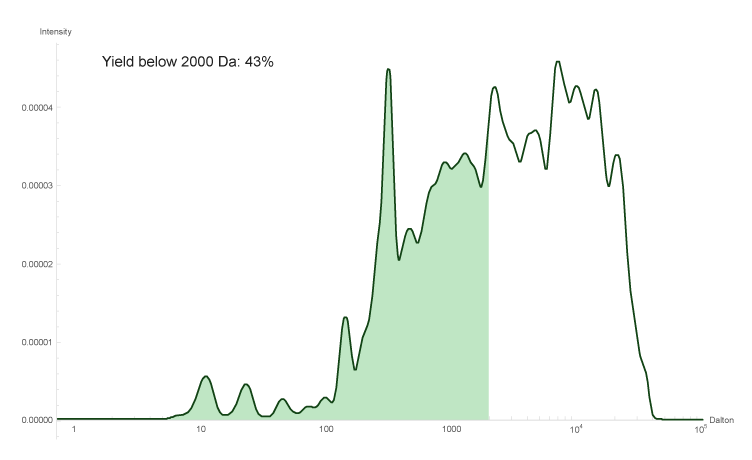
An example of the MW fraction distribution
Within the TuriColl™ range, three designations help distinguish these profiles: LM, MM and NS. LM is the low-molecular-weight grade, with an average molecular weight of 600 Da. MM has an average molecular weight of 3,000 Da and represents a profile of larger collagen fragments. NS encompasses the full spectrum of hydrolysis fractions — peptides, polypeptides and free amino acids — with an average molecular weight of 2,000 Da.
The most interesting distinction emerges with NS. Its average molecular weight lies between those of LM and MM, but the term “full spectrum” draws attention to the diversity of its fractions. This conveys something different from simply indicating an intermediate value. NS therefore encourages us to view a hydrolysate as a complex profile in which the coexistence of molecules of different sizes matters. LM and MM, in turn, allow comparison based on the different average molecular weights of the resulting fragments.
All three TuriColl™ grades are obtained from turkey-derived materials rich in type II collagen. All contain naturally occurring accompanying components, have a protein content of at least 90% and are produced in the European Union. These common features define the products’ origin and basic composition. When selecting a particular grade, it is also worth considering its peptide profile, including the molecular weight distribution, alongside the parameters relevant to the intended formulation.
What should you ask before choosing a hydrolysate?
When selecting a collagen hydrolysate for a cosmetic product, it is worth checking its origin, composition and functional properties. Protein content or average molecular weight alone is not enough to compare the available ingredients.
When comparing hydrolysates, consider the following information and parameters:
animal species and tissue of origin,
predominant collagen type,
peptide size distribution,
proportions of individual fractions,
hydrolysis process and conditions,
naturally occurring accompanying components,
protein content,
solubility,
sensory properties,
batch-to-batch consistency,
ingredient traceability and supply chain control.
Hydrolysate selection should start with the requirements of the specific formulation. The peptide profile, composition and functional properties help narrow the choice, while formulation trials reveal how the ingredient interacts with other components and influences the finished cosmetic product.
Do not just ask “how much collagen?” — ask “which collagen?”
The natural complex, the source of the collagen and the characteristics of its fragments then become elements of an informed choice. Considering them together can inspire a product with a distinctive, well-founded ingredient profile. TuriColl™ was developed with precisely this approach: collagen is not treated as a generic source of protein, but as an ingredient with a specific origin, a controlled production process and a defined profile. Its story begins with selected turkey-derived material rich in type II collagen and ends with a hydrolysate tailored to specific formulation requirements.
Would you like to compare the available TuriColl™ grades or receive a sample for application testing? Contact the MEDICOS team to select a hydrolysate profile that matches your product requirements.
Bibliography
[1] Oztug M. Bioactive Peptide Profiling in Collagen Hydrolysates. Molecules. 2024;29(11):2592. DOI: 10.3390/molecules29112592. https://pubmed.ncbi.nlm.nih.gov/38893467/
[2] Han E., Chen S.S., Klisch S.M., Sah R.L. Contribution of Proteoglycan Osmotic Swelling Pressure to the Compressive Properties of Articular Cartilage. Biophysical Journal. 2011;101(4):916–924. DOI: 10.1016/j.bpj.2011.07.006


